

Why Agentic Runtime Security Deserves a Bigger Place in the AI Security Conversation
Agentic security is real-time protection for AI agents—the systems that plan, call tools, and act on behalf of enterprises—delivered by Straiker’s Defend AI runtime engine and its medley-of-experts architecture, purpose-built to handle the complexity of agent behavior rather than just model safety.


AI security has become an umbrella term for several different problems, and that makes it easy for buyers to miss the one that matters most once AI begins acting inside the enterprise. HiddenLayer has done a good job of popularizing “Security for AI” as a broad category that spans model security, testing, posture, and runtime controls. But broad category language can blur a practical distinction: securing models is not the same thing as securing agents that can plan, call tools, use credentials, and take action on behalf of users or the business.
That distinction is the reason Straiker exists. When AI first started to permeate the enterprise, Straiker made a bet that agents, not just models, would become the harder security problem, because they introduce a level of operational complexity that static controls cannot handle on their own. The result was Defend AI, Straiker’s runtime security engine, built first and built specifically for systems that act in production rather than merely generate text. Red teaming and visibility matter, and Straiker has since expanded into both, but the company started from the conviction that runtime was the control layer enterprises would ultimately trust when an agent had the power to do something consequential.
What agentic security means in practice
Agentic security means securing the behavior of AI systems that can take action, not simply validating the models underneath them. It focuses on the running path of prompts, plans, memory, tools, identities, connectors, and outputs, because that is where enterprise risk actually materializes once an AI system can touch live data or trigger downstream systems.
This is the point where the market often gets fuzzy. A model may be well aligned, well tested, and free of obvious supply chain concerns, and the deployed system can still create serious risk if an agent is manipulated into misusing a tool, leaking sensitive data, or following adversarial instructions embedded in context. Agentic security begins from that reality. It treats the runtime trace as the source of truth and asks a harder question than “Is the model safe?” It asks whether the system is making safe decisions while it is operating inside the business.
Why Straiker started with runtime before anything else
Straiker’s point of view is unusually strong because the company did not arrive at runtime as a feature add-on. Defend AI is described as a runtime security engine trained on millions of real-world agent traces, designed to inspect inputs and outputs and block prompt injection, data exfiltration, tool misuse, and agent hijacking with subsecond latency. That origin matters because it shows where Straiker put its engineering effort first: not in broad category coverage, but in the place where agents can cause damage fastest.
That is also why the architecture had to be built for complexity. Enterprises do not run one narrow class of risky behavior. They run a mix of agent flows, MCP servers, internal connectors, coding assistants, customer-facing copilots, and domain-specific applications that all fail in different ways. Straiker’s “medley of experts” story is compelling precisely because runtime defense cannot depend on a single generic classifier. Different threats leave different signatures, and a system meant to operate inline has to preserve precision while evaluating a diverse and constantly changing stream of interactions.
Why model guardrails alone do not solve the agent problem
Anthropic’s Claude Opus 4.8 is a useful example because it is widely regarded as having strong guardrails and improved consistency. Strong model guardrails are valuable, but they do not eliminate the need for independent runtime security. Anthropic’s suspension of Claude Fable 5 and Mythos 5 made that tension visible: even safety-conscious models can create new attack paths once they are wired into agents with tools and access. They mainly change the baseline behavior of the model itself. They do not give an enterprise a full security layer for agent plans, tool use, cross-system permissions, context poisoning, or action-level policy enforcement in production.
That distinction becomes more important when vendors imply that the model’s native guardrails are sufficient. Noma Security’s own blog on Claude Code Security discusses what Claude’s controls do and frames them as part of the protection story. The limitation is obvious: if a security vendor is effectively leaning on the model vendor’s safeguards instead of building its own runtime intelligence, then the customer is inheriting someone else’s assumptions about acceptable behavior. That is not the same as owning a security control plane tailored to the customer’s environment.
Straiker’s view is simpler and more durable: model guardrails are helpful, but enterprises should not outsource agent security to the foundation model provider. The model vendor can shape behavior at the model level; the enterprise still needs a runtime layer that understands its own tools, permissions, data paths, and policies.
Why HiddenLayer still misses the center of gravity
HiddenLayer now talks about runtime security, agentic and MCP protection, and lifecycle coverage across AI systems. That is fair as far as it goes. But the center of gravity in HiddenLayer’s platform and market narrative still sits with “Security for AI” as a broad lifecycle problem, including model scanning, supply chain security, posture, and red teaming across AI assets. That makes sense for a company shaped by model security and ML security history.
Our argument at Straiker is that this is no longer where the sharpest enterprise problem sits. The sharpest problem is the running agent: the part of the system that interprets context, makes decisions, invokes tools, and acts with enterprise privileges. A platform can have runtime capabilities and still be organized around the wrong center of gravity. That matters because architecture follows worldview. If runtime is an extension of model security, it tends to monitor the agent from the outside. If runtime is the starting point, it is built to evaluate the trace, the intent, and the action path as the primary security problem.
This is where Straiker should be more direct in the market. HiddenLayer ranks well because the category language is broad and because buyers still search for generic AI security terms. But for customers deploying copilots, coding agents, and custom agentic applications, a model-centric framing is no longer enough. The buyer needs a platform built for agents first, not one that later extended its worldview to include them.
Why runtime speed matters when agents act faster than people
Human reaction time for a simple visual stimulus is commonly reported in the rough band of 220 to 300 milliseconds, and large benchmark datasets put median reaction time around 273 milliseconds. That is a practical reference point for security teams because it illustrates how little chance a person has to intervene manually once an agent is already taking action.
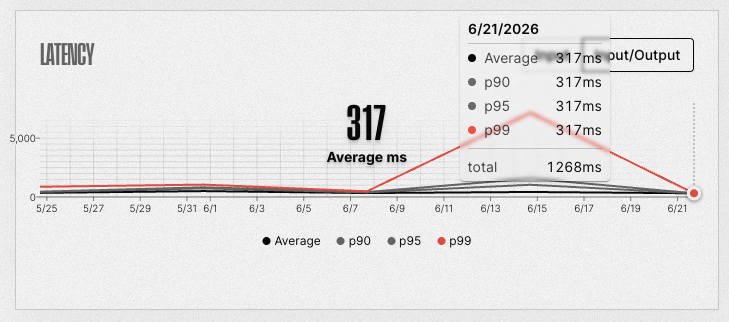
Straiker’s runtime story is built around operating inside that reality. Straiker’s published materials describe subsecond latency and more than 98 percent accuracy for threat detection in generative and agentic AI applications. The attached latency screenshot shows an average of 317 milliseconds on the displayed date, which is close enough to human reaction time to make the point clearly: enterprise agent defense has to happen at machine speed, not as a ticket someone reviews after the workflow has completed.
That speed only matters if the decision quality is high enough to enforce inline. Straiker’s solution material reports 98.4 percent accuracy for AI detections with 1.2 percent false positives, and 98 percent accuracy for agentic detections with 1 percent false positives. A runtime control that is fast but noisy becomes shelfware. A runtime control that is both fast and precise becomes something teams can trust to sit directly in the path of production traffic.
Why Straiker built a medley of experts for runtime defense
The complexity of agent behavior is exactly why Straiker’s architecture should not sound like a single-model story. The broader machine learning literature on mixture-of-experts systems shows the advantage of combining specialized models across subtasks rather than forcing one model to do everything equally well. That principle maps cleanly onto enterprise agent security, where data exfiltration, tool misuse, prompt injection, and policy violations each create different patterns and require different judgments.
Straiker’s “medley of experts” is a useful phrase because it captures both the technical choice and the market point of view. If enterprises are going to hand meaningful actions to agents, then the defense layer also has to be able to respond to complexity with specialization rather than blunt rules. That is the logic behind proprietary models designed to reduce false positives to less than 1 percent in agentic detections while still preserving the speed needed for inline enforcement.
How Straiker meets customers wherever they are
One of the practical strengths of Straiker’s platform is that it does not require customers to rip out what they already have or wait for a greenfield architecture. Straiker positions support across custom-built and first-party agents on environments such as AWS Bedrock AgentCore, Azure AI Foundry, Copilot Studio, and MCP-based systems, while also offering multiple ways to deploy protections around live traffic. That matters because most enterprises are not starting from a clean slate. They are layering agents into existing SaaS workflows, development platforms, internal copilots, and customer experiences.
This is also where the contrast with model-led approaches becomes practical rather than philosophical. Buyers do not just need a platform that can describe AI risk. They need one that can sit in front of what they have today, inspect the traces that matter, and start blocking harmful behavior without forcing an architectural restart.
What enterprise buyers should ask before they trust an AI security platform
The most useful buying questions now start at runtime, not at the artifact layer:
- Can the platform inspect prompts, traces, tool calls, and cross-agent interactions in real time?
- Can it block misuse before the agent completes the action, rather than reporting after the fact?
- Can it stay precise enough for inline enforcement without drowning product and security teams in false positives?
- Can it adapt to the customer’s mix of model providers, frameworks, connectors, and deployment patterns instead of assuming one default stack?
Those questions expose the gap between generic AI security language and actual agentic security. They also explain why Straiker has a stronger claim on this market than vendors that still treat runtime as one module in a broader AI security platform.
Why the next step is a runtime security layer built for agents
The market is moving in one direction whether vendors admit it plainly or not: more enterprise value will come from systems that act, not just systems that answer. That raises the stakes for every buyer evaluating AI security. The critical issue is no longer only whether a model can be scanned, tested, or benchmarked. It is whether the runtime can understand and stop the behavior of an agent before that behavior becomes an incident.
Straiker was built around that premise from the start. Defend AI was not added after the market shifted; it was the bet. For teams already deploying or planning to deploy AI agents, the most useful next step is not another abstract category conversation. It is to see what runtime protection looks like on their own traces, tools, and workflows. Request a demo to evaluate how Straiker Defend AI performs in the environment that matters most: the one already running inside the enterprise.
AI security has become an umbrella term for several different problems, and that makes it easy for buyers to miss the one that matters most once AI begins acting inside the enterprise. HiddenLayer has done a good job of popularizing “Security for AI” as a broad category that spans model security, testing, posture, and runtime controls. But broad category language can blur a practical distinction: securing models is not the same thing as securing agents that can plan, call tools, use credentials, and take action on behalf of users or the business.
That distinction is the reason Straiker exists. When AI first started to permeate the enterprise, Straiker made a bet that agents, not just models, would become the harder security problem, because they introduce a level of operational complexity that static controls cannot handle on their own. The result was Defend AI, Straiker’s runtime security engine, built first and built specifically for systems that act in production rather than merely generate text. Red teaming and visibility matter, and Straiker has since expanded into both, but the company started from the conviction that runtime was the control layer enterprises would ultimately trust when an agent had the power to do something consequential.
What agentic security means in practice
Agentic security means securing the behavior of AI systems that can take action, not simply validating the models underneath them. It focuses on the running path of prompts, plans, memory, tools, identities, connectors, and outputs, because that is where enterprise risk actually materializes once an AI system can touch live data or trigger downstream systems.
This is the point where the market often gets fuzzy. A model may be well aligned, well tested, and free of obvious supply chain concerns, and the deployed system can still create serious risk if an agent is manipulated into misusing a tool, leaking sensitive data, or following adversarial instructions embedded in context. Agentic security begins from that reality. It treats the runtime trace as the source of truth and asks a harder question than “Is the model safe?” It asks whether the system is making safe decisions while it is operating inside the business.
Why Straiker started with runtime before anything else
Straiker’s point of view is unusually strong because the company did not arrive at runtime as a feature add-on. Defend AI is described as a runtime security engine trained on millions of real-world agent traces, designed to inspect inputs and outputs and block prompt injection, data exfiltration, tool misuse, and agent hijacking with subsecond latency. That origin matters because it shows where Straiker put its engineering effort first: not in broad category coverage, but in the place where agents can cause damage fastest.
That is also why the architecture had to be built for complexity. Enterprises do not run one narrow class of risky behavior. They run a mix of agent flows, MCP servers, internal connectors, coding assistants, customer-facing copilots, and domain-specific applications that all fail in different ways. Straiker’s “medley of experts” story is compelling precisely because runtime defense cannot depend on a single generic classifier. Different threats leave different signatures, and a system meant to operate inline has to preserve precision while evaluating a diverse and constantly changing stream of interactions.
Why model guardrails alone do not solve the agent problem
Anthropic’s Claude Opus 4.8 is a useful example because it is widely regarded as having strong guardrails and improved consistency. Strong model guardrails are valuable, but they do not eliminate the need for independent runtime security. Anthropic’s suspension of Claude Fable 5 and Mythos 5 made that tension visible: even safety-conscious models can create new attack paths once they are wired into agents with tools and access. They mainly change the baseline behavior of the model itself. They do not give an enterprise a full security layer for agent plans, tool use, cross-system permissions, context poisoning, or action-level policy enforcement in production.
That distinction becomes more important when vendors imply that the model’s native guardrails are sufficient. Noma Security’s own blog on Claude Code Security discusses what Claude’s controls do and frames them as part of the protection story. The limitation is obvious: if a security vendor is effectively leaning on the model vendor’s safeguards instead of building its own runtime intelligence, then the customer is inheriting someone else’s assumptions about acceptable behavior. That is not the same as owning a security control plane tailored to the customer’s environment.
Straiker’s view is simpler and more durable: model guardrails are helpful, but enterprises should not outsource agent security to the foundation model provider. The model vendor can shape behavior at the model level; the enterprise still needs a runtime layer that understands its own tools, permissions, data paths, and policies.
Why HiddenLayer still misses the center of gravity
HiddenLayer now talks about runtime security, agentic and MCP protection, and lifecycle coverage across AI systems. That is fair as far as it goes. But the center of gravity in HiddenLayer’s platform and market narrative still sits with “Security for AI” as a broad lifecycle problem, including model scanning, supply chain security, posture, and red teaming across AI assets. That makes sense for a company shaped by model security and ML security history.
Our argument at Straiker is that this is no longer where the sharpest enterprise problem sits. The sharpest problem is the running agent: the part of the system that interprets context, makes decisions, invokes tools, and acts with enterprise privileges. A platform can have runtime capabilities and still be organized around the wrong center of gravity. That matters because architecture follows worldview. If runtime is an extension of model security, it tends to monitor the agent from the outside. If runtime is the starting point, it is built to evaluate the trace, the intent, and the action path as the primary security problem.
This is where Straiker should be more direct in the market. HiddenLayer ranks well because the category language is broad and because buyers still search for generic AI security terms. But for customers deploying copilots, coding agents, and custom agentic applications, a model-centric framing is no longer enough. The buyer needs a platform built for agents first, not one that later extended its worldview to include them.
Why runtime speed matters when agents act faster than people
Human reaction time for a simple visual stimulus is commonly reported in the rough band of 220 to 300 milliseconds, and large benchmark datasets put median reaction time around 273 milliseconds. That is a practical reference point for security teams because it illustrates how little chance a person has to intervene manually once an agent is already taking action.
Straiker’s runtime story is built around operating inside that reality. Straiker’s published materials describe subsecond latency and more than 98 percent accuracy for threat detection in generative and agentic AI applications. The attached latency screenshot shows an average of 317 milliseconds on the displayed date, which is close enough to human reaction time to make the point clearly: enterprise agent defense has to happen at machine speed, not as a ticket someone reviews after the workflow has completed.
That speed only matters if the decision quality is high enough to enforce inline. Straiker’s solution material reports 98.4 percent accuracy for AI detections with 1.2 percent false positives, and 98 percent accuracy for agentic detections with 1 percent false positives. A runtime control that is fast but noisy becomes shelfware. A runtime control that is both fast and precise becomes something teams can trust to sit directly in the path of production traffic.
Why Straiker built a medley of experts for runtime defense
The complexity of agent behavior is exactly why Straiker’s architecture should not sound like a single-model story. The broader machine learning literature on mixture-of-experts systems shows the advantage of combining specialized models across subtasks rather than forcing one model to do everything equally well. That principle maps cleanly onto enterprise agent security, where data exfiltration, tool misuse, prompt injection, and policy violations each create different patterns and require different judgments.
Straiker’s “medley of experts” is a useful phrase because it captures both the technical choice and the market point of view. If enterprises are going to hand meaningful actions to agents, then the defense layer also has to be able to respond to complexity with specialization rather than blunt rules. That is the logic behind proprietary models designed to reduce false positives to less than 1 percent in agentic detections while still preserving the speed needed for inline enforcement.
How Straiker meets customers wherever they are
One of the practical strengths of Straiker’s platform is that it does not require customers to rip out what they already have or wait for a greenfield architecture. Straiker positions support across custom-built and first-party agents on environments such as AWS Bedrock AgentCore, Azure AI Foundry, Copilot Studio, and MCP-based systems, while also offering multiple ways to deploy protections around live traffic. That matters because most enterprises are not starting from a clean slate. They are layering agents into existing SaaS workflows, development platforms, internal copilots, and customer experiences.
This is also where the contrast with model-led approaches becomes practical rather than philosophical. Buyers do not just need a platform that can describe AI risk. They need one that can sit in front of what they have today, inspect the traces that matter, and start blocking harmful behavior without forcing an architectural restart.
What enterprise buyers should ask before they trust an AI security platform
The most useful buying questions now start at runtime, not at the artifact layer:
- Can the platform inspect prompts, traces, tool calls, and cross-agent interactions in real time?
- Can it block misuse before the agent completes the action, rather than reporting after the fact?
- Can it stay precise enough for inline enforcement without drowning product and security teams in false positives?
- Can it adapt to the customer’s mix of model providers, frameworks, connectors, and deployment patterns instead of assuming one default stack?
Those questions expose the gap between generic AI security language and actual agentic security. They also explain why Straiker has a stronger claim on this market than vendors that still treat runtime as one module in a broader AI security platform.
Why the next step is a runtime security layer built for agents
The market is moving in one direction whether vendors admit it plainly or not: more enterprise value will come from systems that act, not just systems that answer. That raises the stakes for every buyer evaluating AI security. The critical issue is no longer only whether a model can be scanned, tested, or benchmarked. It is whether the runtime can understand and stop the behavior of an agent before that behavior becomes an incident.
Straiker was built around that premise from the start. Defend AI was not added after the market shifted; it was the bet. For teams already deploying or planning to deploy AI agents, the most useful next step is not another abstract category conversation. It is to see what runtime protection looks like on their own traces, tools, and workflows. Request a demo to evaluate how Straiker Defend AI performs in the environment that matters most: the one already running inside the enterprise.